Leveraging AI and Deep Learning to automate battery upcycling

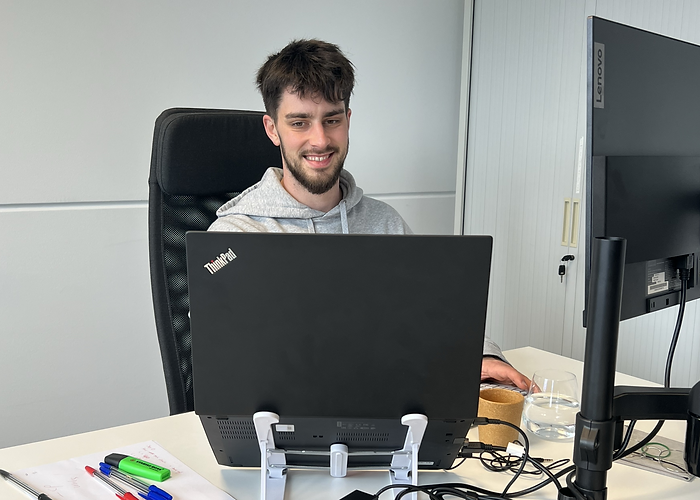
Do you remember our Data Scientist Max? He wrote his Master Thesis at the University of Luxembourg in collaboration with R3 Robotics. His focus: Object localization and classification for automated battery upcycling. In this blog post, Max explains how AI and deep learning can help enable a circular battery value chain.
Why did you choose to focus your research on automated battery upcycling in collaboration with R3 Robotics?
Max: Firstly, the battery upcycling technology has a huge environmental impact on reducing battery waste as well as sustainable recycling. By showcasing the potential of AI and deep learning in enhancing the efficiency of battery upcycling, we can inspire innovation and encourage the adoption of green technologies across industries. Secondly, this topic highlights the significance of interdisciplinary collaboration in solving complex environmental challenges, demonstrating how data science can contribute to sustainability.
What did you find out about object localization and classification?
Max: Within my Master Thesis project, important image data of Ninebot battery packs, used e.g. in E-scooters, were collected and stored enabling easy access for future use. From this data two different object localization and classification models were trained to reliably classify Ninebot battery packs into upcycling or recycling based on visual features.
Were there battery packs falsely classified as ready to recycle?
Max: In the case of misclassification, it was more often the case that a recycling battery pack was mislabelled as upcycling. This means that if the model's predictions are not correct, there are no valuable intact battery packs at risk of being disposed.
How do these results benefit R3 Robotics?
Max: This project helps R3 Robotics's mission to revolutionize the battery recycling industry. An AI-powered classification system improves the accuracy and efficiency of the battery upcycling process. This does not only enhance the company's capacity to recover valuable materials, but also reduces environmental impact and operational costs. The advantage lies in the collaborative nature of the project, where academic research meets industrial application, resulting in innovative solutions that address real-world problems.
Thank you for sharing your contribution, Max!
You'd like to join the revolut-ion as well?
Find more information and open positions here.
Photo: Max Sinner
Source: The information presented is derived from Max's Master's Thesis and the collaborative project between the University of Luxembourg and R3 Robotics S.A.
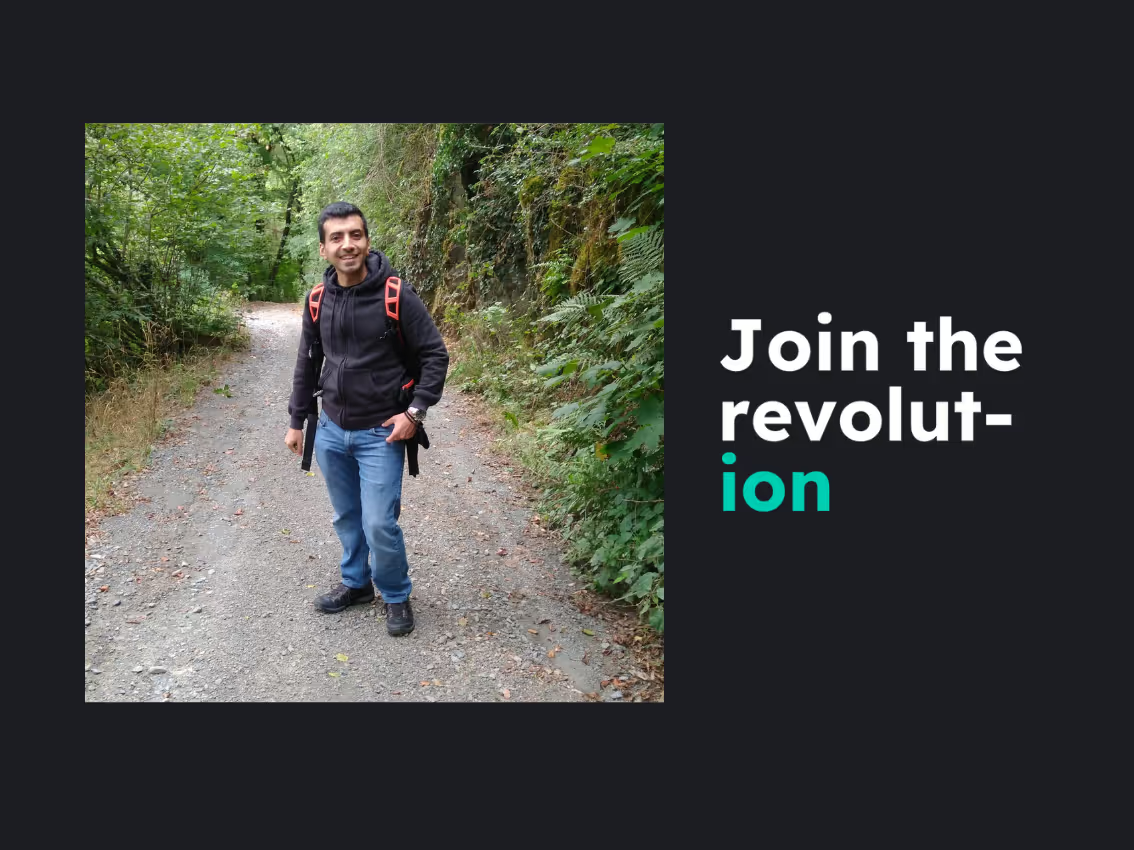
Say hello to Khachatur, a passionate engineer who's been on an exciting journey in the world of electrical engineering. Having completed his PhD in Engineering at the University of Luxembourg, Khachatur is all about pushing the boundaries of technology. His main gig initially? Figuring out how to seamlessly integrate battery energy storage systems into power grids.
Before diving into his doctoral studies, he spent nearly four years as an electrical engineer, gaining hands-on experience across various industries. He was the go-to guy for building and testing custom electrical systems, always on the lookout for new ways to solve tricky problems.
What’s your role at Circu Li-ion?
Khachatur: I am a Cell and ESS Engineer at Circu Li-ion. Currently, my main focus is the diagnostics and discharging of batteries and battery energy storage system development. I am taking care of the development of our micromobility battery pack diagnostics and discharging machine that will help increase the number of upcycled batteries and increase the safety of the operation. Also, I am leading the development of our battery energy storage system made of second-life cells and modules that we automatically extract from end-of-life batteries.
What motivated you to join Circu Li-ion?
Khachatur: First of all, the vision of battery and cell upcycling and the ambitions of the company attracted me. Second, I like being hands-on and solving problems. So, the upcoming challenges associated with the big vision of the company made me curious to find solutions and solve them. The decision to join a startup was natural to me as I have worked both in big traditional companies and small startups and I knew that startups move faster and are more fun.
Thans for sharing, Khachatur. Looking forward to the journey ahead!
You’d like to join the revolut-ion as well?
Find more information and open positions here.