Teaching Our Robot to Dismantle a New Battery Pack Is Easier Than You Think

The assumption is understandable. "AI-powered robotic disassembly" suggests that onboarding a new battery pack requires months of downtime, teams of engineers, and a painful re-integration project. In practice, the system can go from a brand-new battery pack to a production-ready disassembly recipe with a minimal engineering footprint. Here is exactly how we have achieved this at R3 Robotics.
Step 1: Battery Intake Process
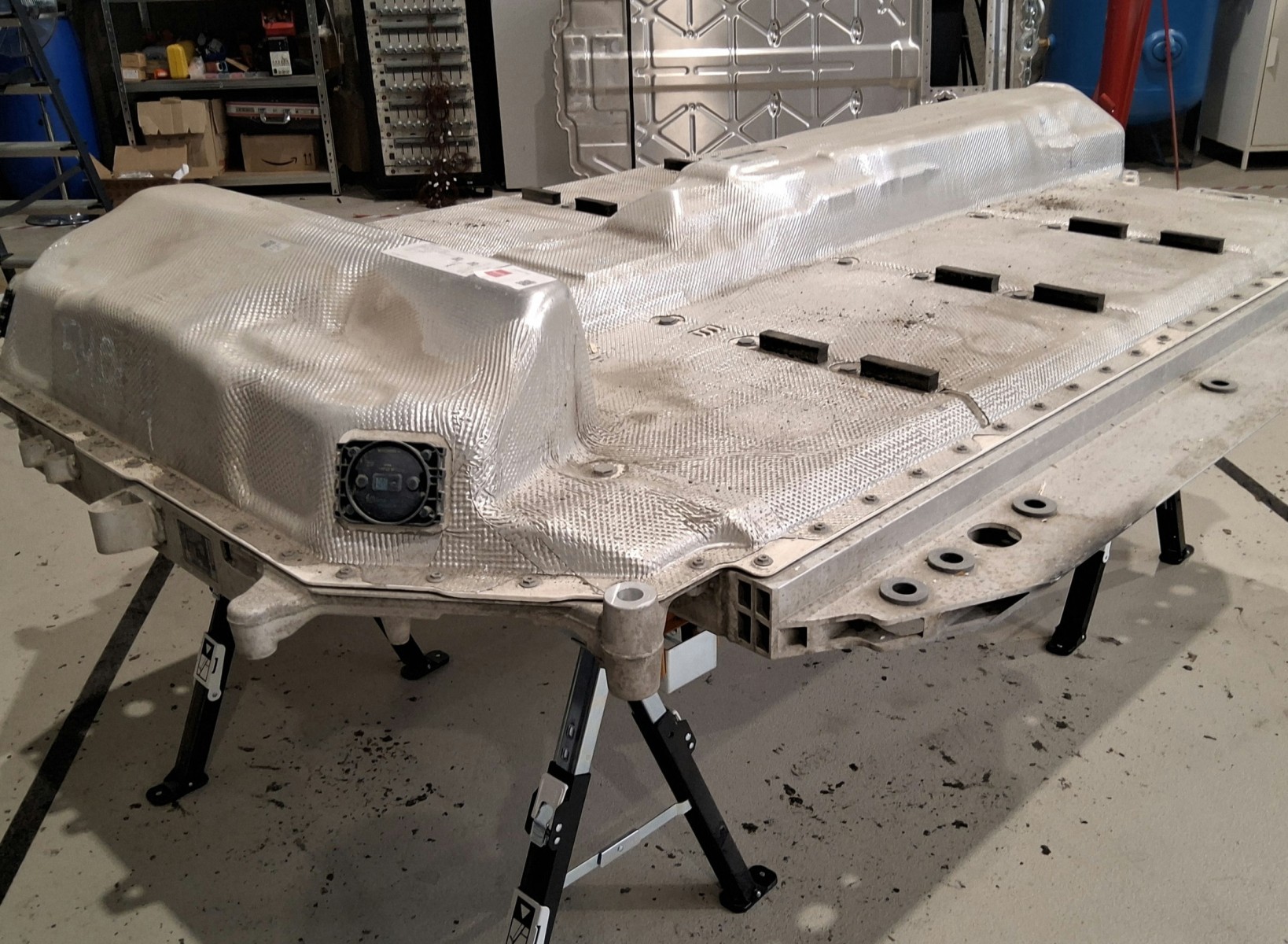
The Battery Intake Process (BIP) is a structured onboarding protocol for every new battery pack model. To date, over 100 BIPs have been completed, spanning BEV and PHEV packs from OEMs including VW, Renault, Tesla, BMW, Mercedes, Stellantis, Nissan, Hyundai, and more than 20 others. This library represents an institutional knowledge base of how the EV fleet is built and how it needs to come apart.
When a new pack arrives, the engineering team treats it as a data collection event. The intake process captures:
- Physical geometry: form factor, cover design, module layout, structural features
- Fastener mapping: type (Torx, hex, socket), head size, thread pitch, length, and depth for every fastener on the pack
- Connectivity: harness routing, busbar positions, connector types, and mandatory discharge steps before disassembly
- 3D scan: a high-resolution point cloud of the pack, which becomes the digital twin used in simulation during recipe creation
Every finding is logged into a central Battery Intake: Disassembly Protocol, structured as a step-by-step disassembly sequence. This document also defines the disassembly process that will guide all subsequent steps. It serves as the single source of truth for everything that follows.
.jpg)
Because many OEM platforms share architecture across model years and variants, a completed BIP for one variant dramatically accelerates intake for the next. The 100+ BIP library covers platforms representing approximately 74% of the BEV market by return volume and 19% of the PHEV market in Europe (2026 estimates), meaning for the majority of end-of-life packs entering the market today, the foundation is already in place before a pack arrives.
Step 2: Recipe Creation
With the Battery Intake data in hand, a disassembly recipe is created — a file that encodes the semi-automated disassembly sequence for that specific battery pack model.
The process follows a defined sequence:
- Skeleton creation: Software engineers define the step structure and skill types based on the disassembly process established during the BIP phase.
- Reachability analysis: Depending on the size and geometry of the battery pack, the robot's ability to access each target fastener is systematically verified in simulation.
- Labelling: Fastener poses are labelled and imported into the recipe.
- Parametrization: The parameters of each skill are adjusted to match the disassembly process defined in the intake phase.
The output is a version-controlled recipe stored in a central repository, traceable by commit. Fully offline recipe creation, with no physical battery required at any stage, is the target state the engineering process is being built towards.
Step 3: Recipe Validation
A recipe built in simulation must prove itself on the physical machine before it can be trusted at scale. Validation is multi-stage and mandatory.
Step 1 — Offline validation: The recipe is tested on the simulation software environment to catch logic and compatibility issues before the machine is involved.
Step 2 — Dry run / Touch test: The recipe is executed on the machine without a battery pack loaded, or with a battery pack present but without triggering actions from the relevant skills. This confirms motion paths and engagement geometry under controlled conditions.
Step 3 — Real life test: The recipe is tested on a battery pack under real conditions. Force profiles, disassembly performance, and overall execution are reviewed and signed off before the recipe is promoted to production.

Why This Matters for Battery Circularity
The EV fleet is fragmenting fast. Dozens of new pack architectures enter the market every year, from 10 kWh PHEVs to 110 kWh long-range BEVs. A disassembly system that cannot keep pace with that variety is not a circular economy asset — it is a bottleneck.
This three-step process is engineered for exactly that challenge: structured, fast, and repeatable onboarding for any new pack model. Every BIP completed adds to a growing library. Every validated recipe raises the baseline for the next. And every platform covered extends the share of the returning EV fleet that can be processed at full automation.
That is what makes robotic disassembly not just technically impressive, but commercially viable.
Want to see it in action? Get in touch with us here.
Say hello to Khachatur, a passionate engineer who's been on an exciting journey in the world of electrical engineering. Having completed his PhD in Engineering at the University of Luxembourg, Khachatur is all about pushing the boundaries of technology. His main gig initially? Figuring out how to seamlessly integrate battery energy storage systems into power grids.
Before diving into his doctoral studies, he spent nearly four years as an electrical engineer, gaining hands-on experience across various industries. He was the go-to guy for building and testing custom electrical systems, always on the lookout for new ways to solve tricky problems.
What’s your role at Circu Li-ion?
Khachatur: I am a Cell and ESS Engineer at Circu Li-ion. Currently, my main focus is the diagnostics and discharging of batteries and battery energy storage system development. I am taking care of the development of our micromobility battery pack diagnostics and discharging machine that will help increase the number of upcycled batteries and increase the safety of the operation. Also, I am leading the development of our battery energy storage system made of second-life cells and modules that we automatically extract from end-of-life batteries.
What motivated you to join Circu Li-ion?
Khachatur: First of all, the vision of battery and cell upcycling and the ambitions of the company attracted me. Second, I like being hands-on and solving problems. So, the upcoming challenges associated with the big vision of the company made me curious to find solutions and solve them. The decision to join a startup was natural to me as I have worked both in big traditional companies and small startups and I knew that startups move faster and are more fun.
Thans for sharing, Khachatur. Looking forward to the journey ahead!
You’d like to join the revolut-ion as well?
Find more information and open positions here.